
I’ve been doing some thinking about the Cheviot of Sad, and about what I wrote last week. Specifically, about the claim that I like crunchy, wooly wool, and how incongruous that claim was with how I actually felt about such a wool. Do I really like wooly wool, I wondered, or do I just like to think of myself as the sort of person who likes wooly wool, in the same way that in my twenties I liked to think of myself as the sort of person who read Nietzsche, and so carted that copy of Thus Spoke Zarathustra through eleventy moves, despite the fact that the bookmark never moved past page 86? Continue reading
You can’t love ’em all
Once again, it’s been too long between posts. Most of October was taken up with putting together submissions for magazines, which cannot be posted about on pain of…well, rejection. I’m also working on a couple of new designs, which are too early in the process to be written about; it’s almost as though exposing them too young will cause failure to thrive. Then November hit, and with it the annual urge to knit ALL the presents. I succumbed this year, against my better judgement, and of course I can’t go posting those projects all over the internets, lest my family see them before their appointed time of unveiling. There is something I’ve been wanting to write about, though, and it contains both spinning and knitting content, so today seems like a good day for it.
An elephant in a day?
A couple of weeks ago, I set myself a challenge. You see, I really wanted to make Ysolda Teague‘s Elijah to send up to Canuckia with The Nephew’s birthday sweater. The sweater took too long, alas, and other commitments prevailed, but that day I realized that a) the sweater wouldn’t get to the post office until the next day, and b) it was Sunday, which I have declared watch-eleventy-mysteries-and-knit-what-you-want day. (Midsomer Murders is my current series of choice, and it looks like that well may never run dry.) So, the question was, could I make an elephant in a day? I had to find out. For SCIENCE!
Step 1: A strong cup of tea. Well, actually, a pot.

Step 2: Convince Chicken-Leg Al the Wonder Cat to relinquish the yarn.

It being Sunday, I was hardly up with the birds, and this idea didn’t occur to me until I was two cups into the day. Thus, at the civilized hour of 10:37am, my needles and I got to work. I knit like the wind. Like the wind, I say. Took a break for lunch at 1:15, and was back to work by 1:40, with a second pot of tea. Green this time; my black tea is like rocket fuel, and two pots of that would leave me a gibbering idiot. Or more of a gibbering idiot.
The head was not quite done, which sounds discouraging, but it took me about half an hour to correctly execute the cast on (an ingenious one for centre-out projects that I had not previously encountered). I figured I still had a chance. By about 2:15 I had me an elephant head, and by 5:15, the body was finished.

At around 8:30, I bound off the second leg. Great day in the morning, I might actually pull this off.
An hour for dinner, then I started the arms. Halfway through the first arm, my dad called. I briefly considered answering with, “Can’t talk; making an elephant,” and hanging up, which is when I realized that I may have lost perspective on this thing. I talked to my dad, then went and had a nice, hot shower to work the kinks out. Then back to work, with only 1.5 arms and an ear to go.
Now here’s the thing: you look at those arms (see below) and think, “That’ll take no time! Look at them. They’re tiny. It’ll be a doddle.” However, each part of this elephant is worked by picking up stitches rather than making it in pieces and sewing it together, and you stuff each piece as you go. This is smart, because it means that the toy has no weak points that will give way to tiny but incredibly strong hands. The tradeoff is that with each piece, you add to the weight and awkwardness that will be hanging off your needles when you work the next piece. So those arms? Not as much of a doddle as you’d think. (I should point out that this pattern is not designed for high-speed competition knitting, and under normal knitting circumstances devoid of ridiculous self-imposed time restrictions, this awkwardness would not really be a problem.) At any rate, I bound off the second arm at 3 am.

Exhausted and achey, I realized that poor Mr. Olliphaunt would have to remain earless for the night. Or, as it turned out, for several nights. After about 16 hours of almost constant labour over this thing, it was a couple of days before I could pick Ollie up again. He did get finished in the end, though, and was last seen being dragged about by one of those ears, clutched in the hands of a loving toddler who would shout “OLLIPHAUNT!” at the slightest provocation.

Thus we learn that should the occasion arise when the swift production of a small, stuffed pachyderm is all that stands between humanity and imminent destruction, I may not be your gal, but I’ll give it a good, solid try. Also that self-imposed olympic-style knitting challenges are a bit silly.
Tutorial: Stick a leaf on it
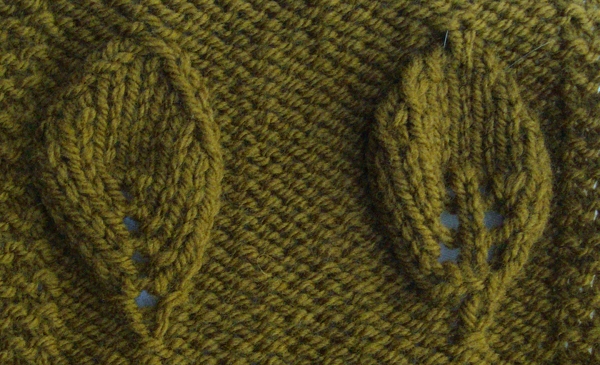
So my car knitting shawl/scarf thingy is coming along nicely,
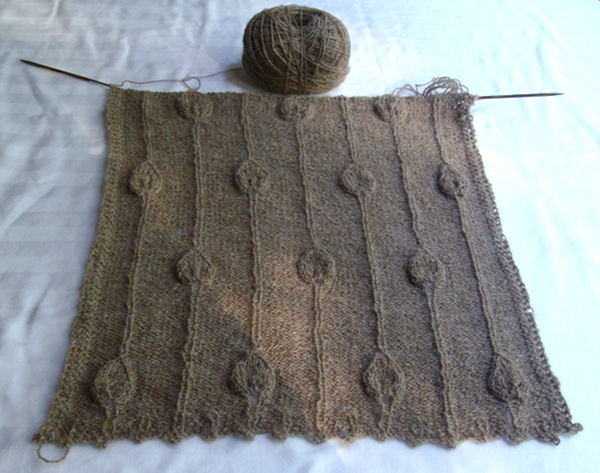
and I was thinking about how useful the embossed leaf motif is. It’s easy: a series of increases at the bottom, some straight rows if you wish, and a series of decreases at the top. It’s adaptable: you can change the appearance, shape, and size by changing the type and placement of your increases and decreases. It’s self-contained: an embossed leaf grows and shrinks independently of the rest of the piece, so that you can keep doing whatever you were doing for the rest of the stitches, and at the end of each leaf you’re back to the same stitch count you had at the beginning. If you prefer your leaf to be flat, rather than raised, you can use corresponding decreases and increases outside the edge of leaf, keeping the overall stitch count constant. Continue reading
Maybe a Dahlia
There’s this cardigan. Her name is Dahlia. I loved her as soon as I saw her, but I let practicality stand between us and I filed her away on a wish list entitled Things I Shall Make When I Have Time. My friend Susan and I joked about how, beautiful as she was, we would probably never get around to making her. Susan even started a Never Get It Done-Along for Dahlia, a sort of ongoing online party where we could talk about her loveliness, waffle about yarn choices, and dream of what our versions would look like, without any pressure to actually make her. In my stash was a yarn that I was sure would be perfect: some merino/bamboo/silk heavyish fingering weight by The Plucky Knitter in the delightfully-named colourway Mildred Pierce. I even made a gauge swatch. It was perfect the first time. The yarn was a dream to knit with. I was sunk.

As of Saturday night, I could resist no longer. Whistling past the designs-in-progress pile, shielding my eyes from the spectre of a thousand unfinished objects, I cast on for Dahlia. I worked on her as we watched Last Life in the Universe, and well into the night. Sunday at around dawn, when Chicken-Leg Al, Prince Among Cats summoned me to door duty*, I brought Dahlia outside to knit while drinking my morning gallon of tea. As the chilly early morning gave way to a warm, sunny afternoon and then cooled into evening, the central lace motif expanded and unfolded in my hands until it became this:

Somewhere in here I wanted to wax poetic about how Last Life in the Universe was the perfect film to go with Dahlia; how the story reveals itself to you slowly, quietly, occurring mostly between the lines, as the petals of the lace pattern unfurl until much to your surprise, you have created a beautiful, delicate thing. Everything I came up with sounded much too purple, though — too clumsy and obvious and sledgehammery for such a subtle satisfaction — so I won’t. Except that I just did. Ah, well. But really, this is one of those patterns that you look at think, “Oh! How pretty!” Then you work on it and realize just how clever it is: how carefully all the increases and decreases — the type, the placement — were put together to make this intricate design. The way the rest of the garment grows out from the lace panel is equally interesting, and I look forward to that part almost as much. Dahlia is even more clever than she looks, and I’ll be watching for more designs from Heather Zoppetti.
Now it’s Monday, time to get back to more worklike knitting. Come evening, though, I may pull Dahlia out of the basket and work on her some more. Just a couple of rows. Just to finish the next piece.
*Chicken-Leg Al has a new trick to ensure that I do not neglect my duty as dawn doorperson. It’s called ‘Mum’s Lower Abdomen is My Parade Ground.’ It’s marginally less irritating than its predecessor, ‘Metal Blinds are Satan’s Xylophone’, and at least as effective.
Gimble
The writing and testing and tech editing and foofaraw are done, and the pattern for Gimble has been released. w00t!
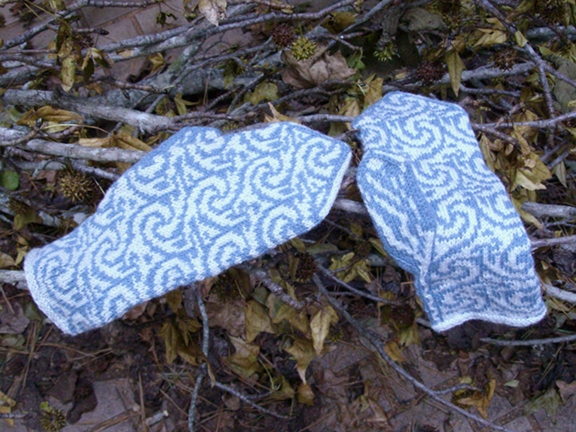
I designed Gimble with longish, close-fitting cuffs and a Scandinavian thumb. The cuffs go a few inches up under your coat sleeves because oh, mama, do I hate cold wind and snow on my wrists. I went with a Scandinavian thumb because I find that the thumb gusset — that ‘V’ shape at the base of the thumb that comes out from the mitten — tends to fit better, providing extra room for the ball of your thumb. This shape can be a bit trickier to design for, but it’s worth it.
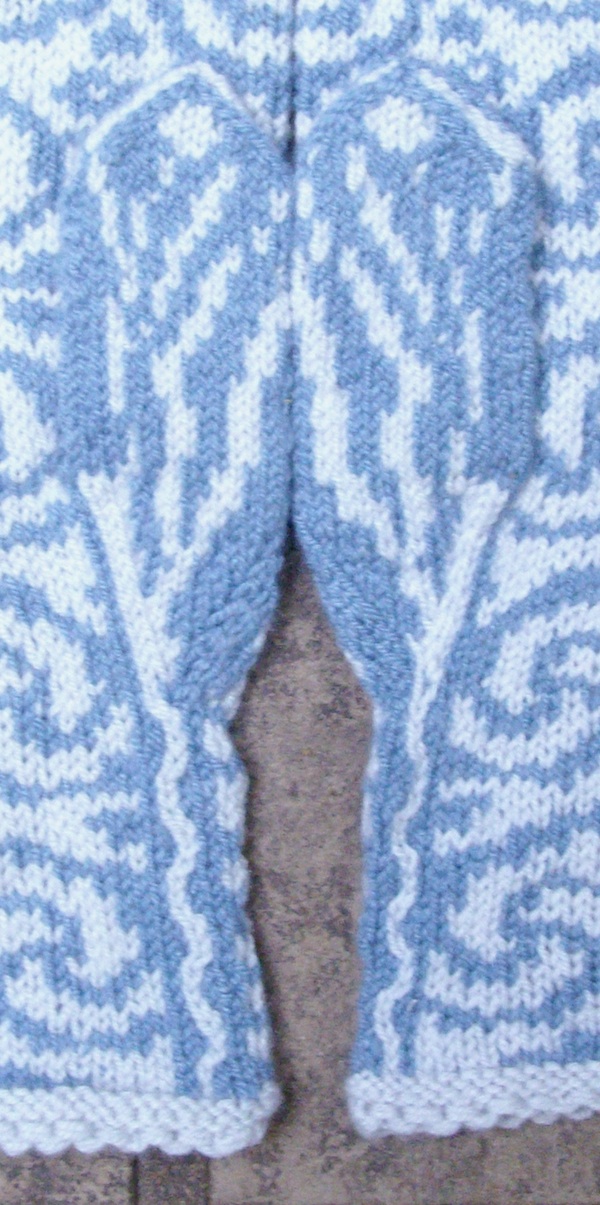
These mittens are designed to go with Gyre, though in fingering weight rather than DK. I used Quince & Co.’s Tern for this pattern, and wow, do I love this yarn. Definitely wooly, with a nice sproinginess to it, softened by the 25% silk. Plus, the colours have a quiet loveliness to them that really appeals to me. I’ve been doing some swatching, and the corresponding colours of Chickadee would work for Gyre, if you wanted to make a matching set. A thousand thank yous to my doughty testers, Heike and Jerrica.
Fall knitting and colourwork. Huzzah, I say.
Just a little car knitting
Coming off the high of last week’s get-it-done-athon, I decided to treat myself. I mean, look how productive I’d been, right? Surely I could do something small. For variety. As a palate-cleanser, if you will, and a reward. “Oh, I know!” thought I, “There’s that 2 oz of delicious cria alpaca waiting to be spun! It’s tiny. It won’t take long. I’ve got two bobbins free…ish. A couple of evenings, tops, and then I’ll get back to finishing ALL the things.”
Yeah.
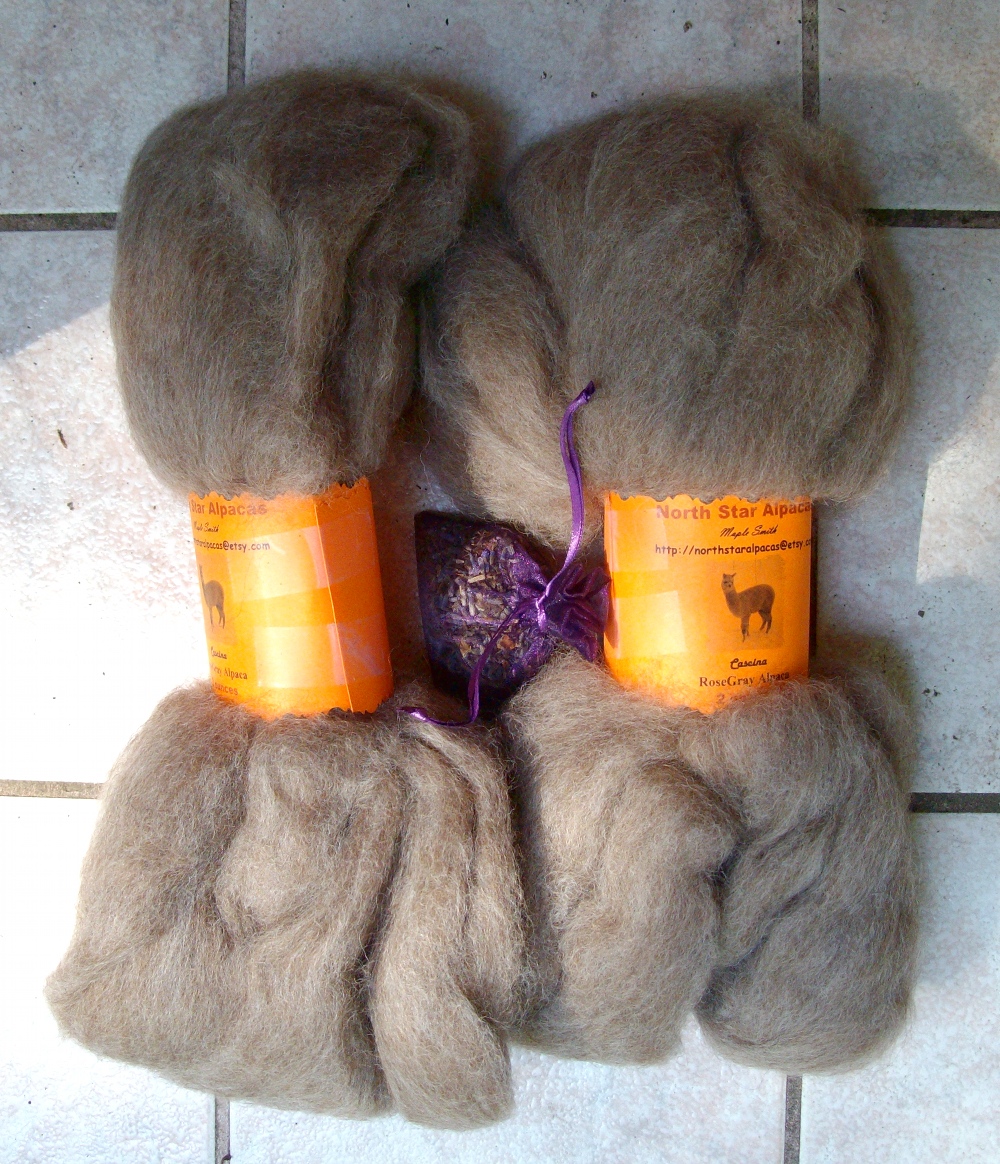
I was right, up to a point: the alpaca — rose gray cria roving (the first real shearing from a baby alpaca) from North Star Alpacas — did spin up quickly. I’d never spun alpaca before (apart from a sample at spinning lessons) and was a bit nervous that I’d screw it up, but the carded prep was smooth like butter, and made for some of the most effortless spinning I’ve ever done. Even worsted spun, the singles were nicely fuzzy, and the softness…oh, the softness. Plus, Maple had put a lavender sachet in the bag, so I’d get these delightful wafts of lavender as I spun it up. Even Chicken-Leg Al the Wonder Cat was powerless against it: he took about 3 seconds to go from, “Hmmm, what’s this new fluffy thing?” to full-on drooling alpaca faceplant. About halfway into the first ounce, I went back to the site and bought another 4 oz. You can see where this is going.

Around the same time, I realized that we had a 6 hour road trip coming up — 3 hours each way — and none of the projects on the needles would make for good car knitting. They all require charts and/or concentration, which is a recipe for nausea and much ripping out of mistakes. Why not cast on something with my newly made yarn? Something simple; something that didn’t require charts; something I could knit without looking at it too much; something to show off the handspun-ness of the yarn. So I did some swatching and came up with a stitch pattern I liked.
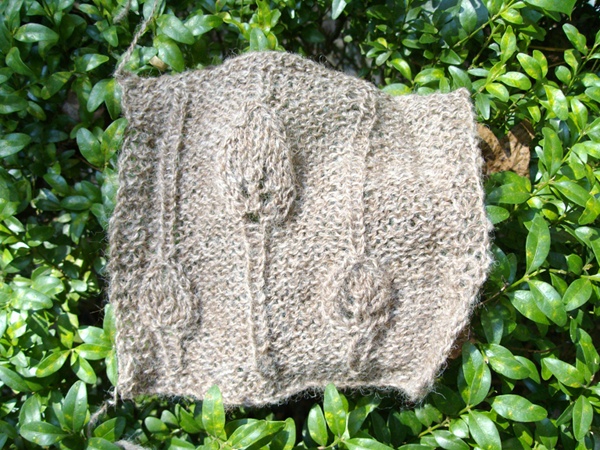
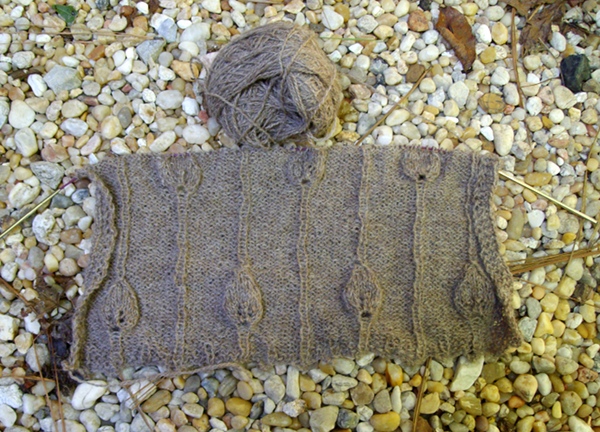
I got about 250 yds/229 m of 2-ply from a generous 2 oz/57g of roving, so I’d end up in the ballpark of 750 yds/687m, which might be enough for a shawl, if I made it narrower than my usual giant wrap. If not, I could always spin some more. Perhaps I should order another 2 oz to be safe. A shawl, yes. That will take rather more than 6 hours and require the spinning of another 4-6 oz of roving.
You know, a little car knitting.
Getting things done
Oh, the things I shall do when I do all the things. All these things that I dream, I shall do.
But probably not today.
That’s kind of been my mantra for the last couple of weeks. So many ideas; so many projects I’d like to do; only two hands and a mere twenty-four hours in a day, not all of which can be devoted to projects.
About two weeks ago, I reached a point. Whether or not you’re a knitter, you know the point I’m talking about: when the thought of adding one more thing to the pile of things to be done makes your face go all squinchy like an overwhelmed toddler’s and you start to wonder whether standing in the middle of the room and stamping your feet would make it go away. “That’s it,” I decided. “I shall finish ALL the things! Or, at least, I shall finish some of the things before I start more things, lest the part of my brain that keeps track of projects starts emitting smoke and making those alarming ‘gzzt gzzt’ sounds.” So I put my head down and I worked on things. I did not finish them all, but Serious Progress Was Made. Here are the things I’ve been working on:
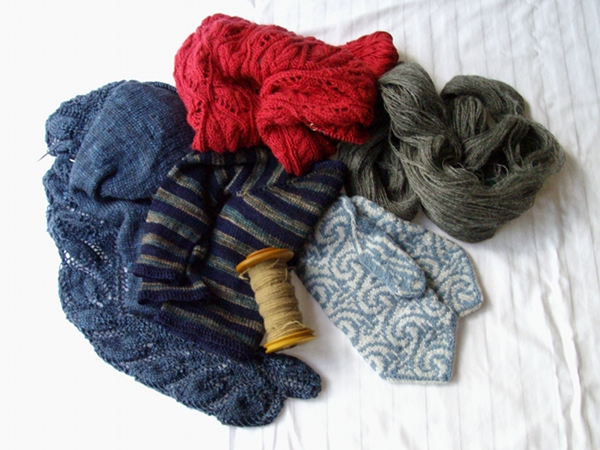
Note: this is not two weeks’ work. Most of these things were started over the summer, but in the last two weeks I have worked on them solidly, so that now those that are not finished are at least well on the way there. The almost-there things are:

An oversized baby blanket version of Anne Hanson’s Hourglass Throw, in Plymouth Baby Bunny. I started this in July for my cousin’s new baby, choosing red because we didn’t know its sex and because I like bright colours for babies (the better to hide the puke stains, my dear), and making it oversized because one thing we did know was that the baby would be tall. Or long. I guess they’re not tall until they can stand up. With two former basketball players for parents, this was not exactly a shock. So I’ve added an extra pattern repeat on the side, which should balance out the extra repeat or two I’ll add to the length. This will also act as insurance in case I don’t finish the blanket until the baby is too big for it. But of course, that’s not going to happen, because it’s on the list of Things To Be Finished.
Next:
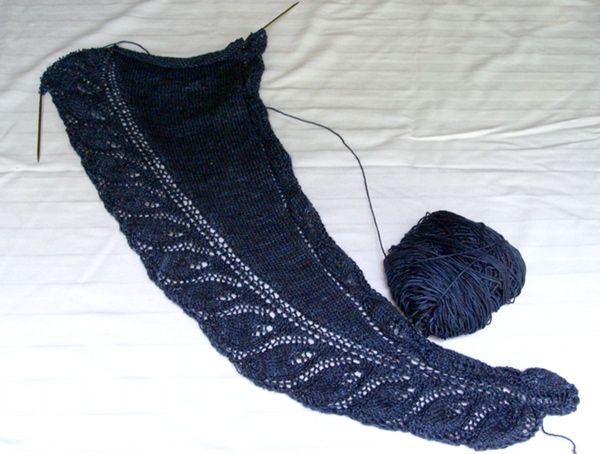
A shawl for me: Semele by the very talented Åsa Tricosa, knit in some soft, rich Squoosh Silky Sock. I have a Thing coming up this Friday about which I’m a bit nervous, so I wanted something stunning to wear: something that I had made and was proud of and could wrap around me to remind myself that when I put my mind to it, I f$#king rock. Also something that could cover the tattoo on my chest, if need be. I didn’t have time to design something (and sometimes you just want to follow someone else’s pattern, you know?) and I think this design is ingenious. It’s just past the half way point, and stands a fair to middling chance of being done on time.
Third:
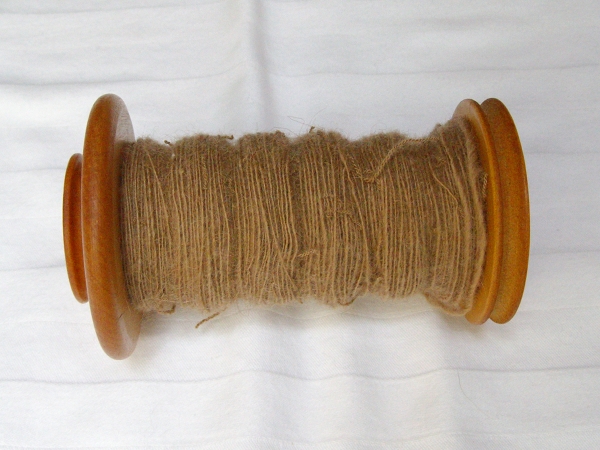
That baby camel down I posted about a while back. I’ve done the first singles (yes, it’s plural, even though there’s only one. No, I don’t know why. Eventually it will stop looking weird to me.), so just need to do the same again and ply it. I could fill the bobbin, but decided that this was enough to get started with, so I can play around with the finished yarn and see how well it works and what it wants to be.
Now for the finished things.
One:
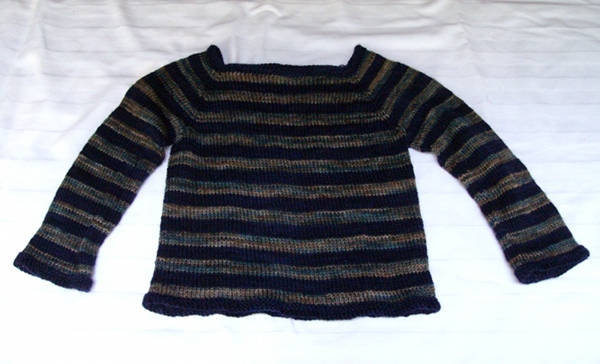
The stripey sweater! It’s late for nephew’s birthday and probably a bit big, but I don’t think he’ll mind. I’m so pleased with how this turned out, though I must remember that even in little sizes, sock yarn sweaters will take longer than you think. Also, no matter what the pattern says, I always, always, always need to go down a needle size for the edging. Why I forget this, I do not know. Next time.
Two:
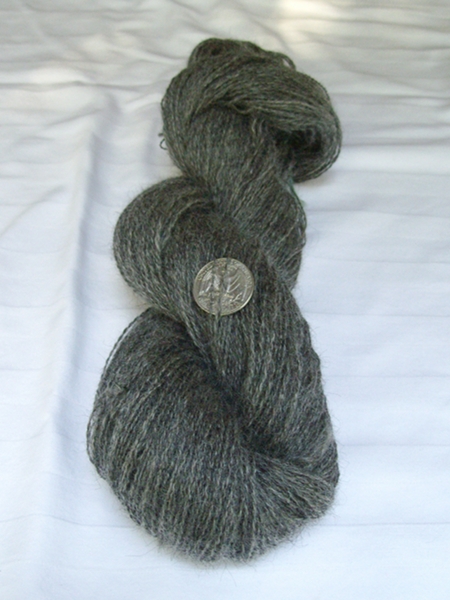
The second skein of Gotland wool. This one came in at 576yds/527m to 5.35 oz/151g. Hopefully it works with the other skein and between them I have enough for the giant winter wrap I have in mind, because I think I’m done spinning this stuff for a while.
Three:

Mittens! I finished this sample a couple of weeks ago, and now the last test knitter’s feedback is in. Today we’ll get the photos done and I’ll give the whole thing a final polish and send it off to Kate the Wonder Editor, so I can release the pattern soon. Ahhhhhh. It feels good to get that (almost) done.
Also finished are the charts and swatch for a design that’s been niggling at me since the spring. Yes. No photos yet, though.
It’s been a busy couple of weeks.
Handspun spinning slippers, the knitting thereof
Being Part II of the tale of the handspun spinning slippers. Part I is here.
So I have my lovely yarn:
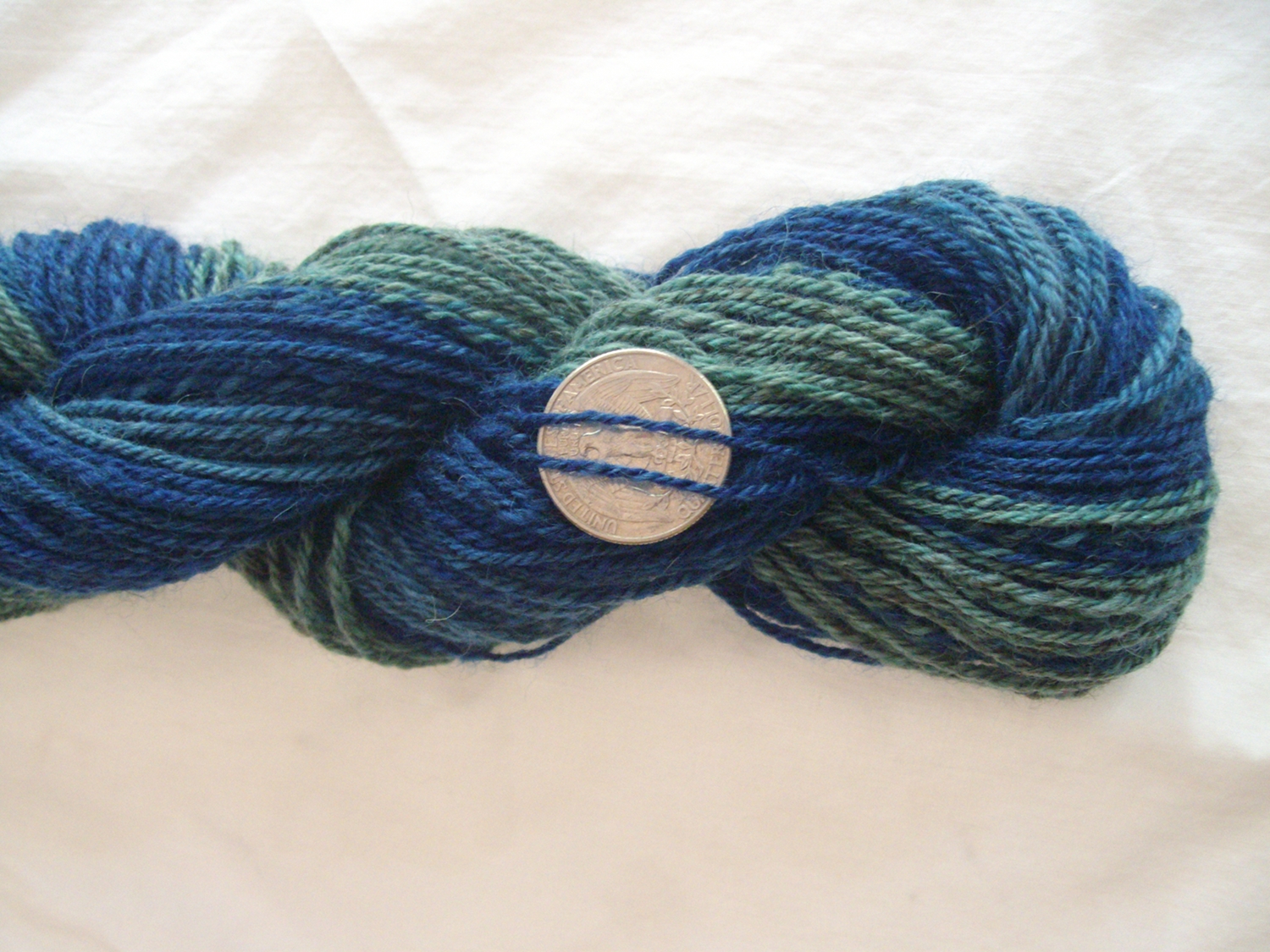
and I want to turn it into slippers like these. There are a few complications, though: the handspun is probably a bit heavier than the recommended yarn (which I would know for sure if I had a gauge to measure wraps per inch, or even a wooden ruler that was less than a yard long. I don’t. It’s on my list.); I don’t have a lot of it, and don’t want to use any of it to make a gauge swatch; I’m impatient — this is my first usable yarn, and dammit, I just want to make something; the pattern is ‘one size’, and I can guarantee you that size will not accommodate my rather large feet. I was going to have to wing it.
At this point in the story, I run into a quandary, dear reader. I would love to say exactly how I made the slippers, but I won’t. The result is too much like the original design, and I can’t in all conscience post detailed instructions for making them here when Reiko has gone to a lot of trouble to write a pattern, especially since she is using the proceeds to help people. Also, did I mention that I didn’t do a gauge swatch? So I won’t be providing numbers here; you’ll have to buy the pattern for those. It’s two and a half bucks.
In my humble opinion, the best way to make socks or sock-like foot coverings when you’re short on yarn and/or can’t be arsed to swatch is to do them from the toe up. You run the risk of getting to the heel and finding they don’t quite fit right, but then you haven’t done much more knitting than the swatch would have taken, and you can always rip back. It’s probably a bad idea to do this for yarn with more than about 10% silk (which might grow with washing) or with yarn you’re not that familiar with (again with the post-washing surprise potential), and if you’re planning to machine wash the finished object and haven’t used that yarn before, for the love of all the work you’ve done, make a swatch and wash it the way you’ll wash your socks. That said, there’s something freeing about seat-of-the-pants, toe-up, swatches-be-damned sock making. We’re living on the edge, here.
The Comfort Slippers pattern is top-down, so I’d have to work backwards. I took the end stitch count from the pattern and added a couple of stitches for extra foot width, grabbed two circular needles of what was probably the right size and cast on with Judy’s Magic Cast On. What’s the right size? Well, you’re shooting for a dense fabric, so whatever needle will give you that. If it doesn’t feel right after a few rows, try again. It’s only a few rows; better to redo them than to have drapey socks or socks that stand up on their own.
I increased where the pattern had decreases, trying them on as I went, until they seemed about wide enough (i.e., a bit too loose, as the knitting would pull back once the needles weren’t holding it out). Actually, my increases are a bit closer together, and I wish they weren’t. The next pair, I’ll separate the increases more to make the toes more like the original. When the toe was a bit short of where I wanted it (to allow for edging), I cast off the number of centre top stitches that the pattern had you cast on, did a few more decreases to open up the foot, then knit straight until I was a couple of inches short of the heel. Now, these slippers weren’t going to be worn in shoes, and I was not feeling very mathy, so I just did a short row heel instead of the reinforced heel. More edge decreases to open up the heel, then straight knitting until the back heel was about the height that I wanted it, minus a bit for the strap. Then I picked up stitches around the foot and, ignoring the heel stitches, did three rows of 2×2 ribbing on the picked up stitches, decreasing on the second row where I wanted corners (on each side of the toe and at the turn for the ankle), and binding off in the same rib, leaving the one remaining bind off stitch on the needle. Looking at the pattern again, this is not at all how she did the edging, and I like hers better, so that’s probably what I’ll do next time. I picked up one stitch along the short side of the foot edging just worked, knit across the back, picked up two stitches on the other edge, then cast on stitches for the strap until I had the same number as the pattern. (My ankles are narrower than my feet, so between that and the slight difference in gauge, I figured that would work.) A few rows of 2×2 (until it was about as long as I wanted it), bind off in rib, and voila!
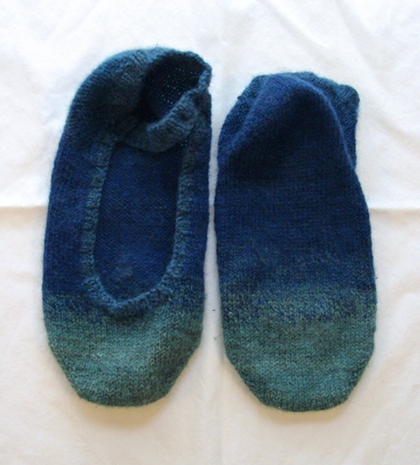
They say that you don’t really learn what your handspun yarn is like until you knit with it, and they’re right. This yarn was pretty in the skein, but a bit hard. Knit up, though, it softened and opened up even before the final wash. (I knit English style — with the yarn in the right hand — which opens up the twist a bit.) After a light blocking, by which I mean give the thing a bit of a soak and dry flat, they were soft and cozy and a bit fuzzy and everything I’d hoped they would be. The slight difference in each single made the colours flow nicely into each other, though I’d had to cut out a fair bit of the darker blue to get the light blue in. And just as I had imagined at the beginning, whenever I get frustrated or bored with something I’m spinning, I look down at my slippers and remember how rewarding the whole process will be.
 E. Elliott Knits