
The observant among you may have noticed a brand new knitting project at the bottom of my last post. “What’s that?” you may have wondered, “A new project? Does that mean she’s finished some of that giant, nagging heap of WIPs?” No. No, it does not, smarty trousers. What it means is that I have this compulsion to use every trip over half an hour long as an excuse to start something new. Continue reading
winging it
Shaking things loose
My, but it’s been a strange and tense few months. The worst is over, though, so we buggered off to New Orleans to celebrate, shake the dust off, and see if we could rediscover our mojo. Strangely, I took very few photos (or rather, I took many photos of very few things) — I was so busy just looking at everything (and tasting, and listening, and and and…). (Also, I’m always afraid that I’ll be the sort of visitor who sees a place only through a camera lens.) Here are a few of my favourite photos, though.
There were hidden places:

Motley
While my computer issues are resolving themselves (or not), here’s a photo of one of the ridiculously late Xmas presents, modelled by my nephew and photographed by my exceptionally talented sister-in-law, Anusha Balram.

I think he likes it.
Info: The blanket is in Malabrigo Rios, in Sunset and Purple Mystery. I made the design up, though I haven’t decided whether to write it up as a pattern — there are a couple of kinks that I’d need to work out first. Looking at this photo, though, I’m seriously tempted.
Colour play 2: The Great Shetland Experiment
Being stage 2 of ongoing experiments in becoming the boss of colour in spinning.
The Cormo spinning progresses apace, but as I mentioned last time, it’s going to take a while, and I have the attention span of a hummingbird on speed. Enter some English Shetland wool from Into the Whirled: one multicoloured braid

Hand me that sheep, Igor
If you spin, you’ve seen them: those braids of fibre, hand painted in glorious blobs of colour, with names like Night Carnival, Autumn Leaves, Mille Fiori. Those braids scare the pants off of me. Now, I love colour. I’m a knitter; I design in colourwork; of course I love colour. But for some reason, faced with those riotous braids, I’m stymied. What the hell would I do with them? What if, despite the dyer’s careful application of their art, I spin them up into something ugly? Something that offends the eye and sends children screaming to their mothers? Those colourful braids hold so much potential, and others have made gasp-worthy yarn from them, yet somehow I’m convinced that in my hands, that potential would go horribly wrong.
Mawata Colossus
It all started with the Yarn Harlot.
You see, I had never heard of mawata until I stumbled upon Stephanie’s post proclaiming the glories of her hand-knit mawata mittens. Like eleventy billion knitters before me, I was intrigued by the idea that these stretched silk cocoons, stacked in layer upon gauzy layer, could be pulled apart and just…knit. And the fabric! So nubbly and colourful, humble yet elegant. I had to make such a fabric. It was an aesthetic imperative. Continue reading
No pressure
Oh, dear. It’s been a while again, hasn’t it? It has been an…interesting month over here at Casa de Cusser, and to be honest, I haven’t felt like I had much to say (or at least, not much that was suitable for this blog. Or children. Or those with sensitive ears. Despite the nickname, I try not to swear on this blog, and there was a lot of swearing going on.) However, it looks like the worst is over (touch every piece of wood in the house), and things don’t seem so bad, and I do have something to write about: the healing properties of stash-diving in times of trouble.
The start of an(other) obsession
Lately, I’ve been thinking a lot about sock yarn. More precisely, I’ve been thinking about spinning sock yarn: how best to spin it, what fibres to use, how to put it all together into The Perfect Sock Yarn. Continue reading
Tutorial: Stick a leaf on it
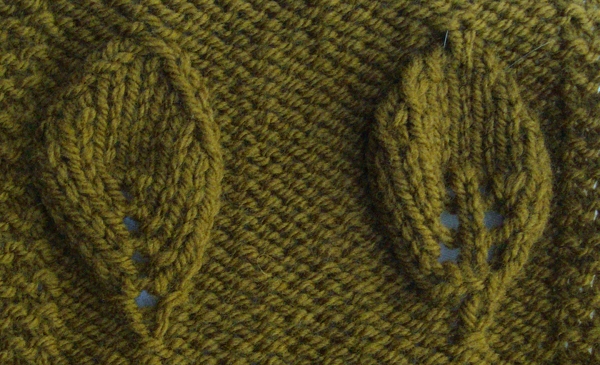
So my car knitting shawl/scarf thingy is coming along nicely,
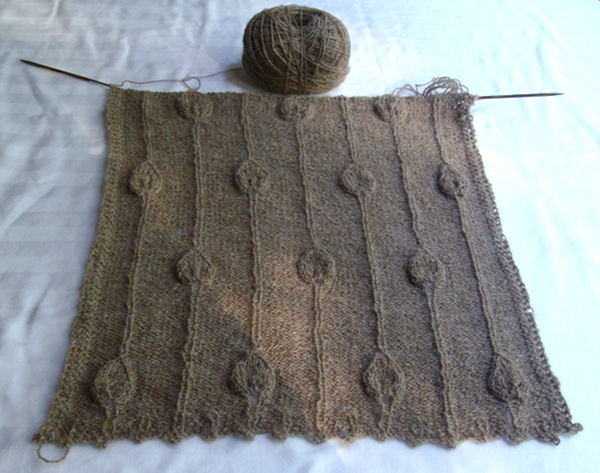
and I was thinking about how useful the embossed leaf motif is. It’s easy: a series of increases at the bottom, some straight rows if you wish, and a series of decreases at the top. It’s adaptable: you can change the appearance, shape, and size by changing the type and placement of your increases and decreases. It’s self-contained: an embossed leaf grows and shrinks independently of the rest of the piece, so that you can keep doing whatever you were doing for the rest of the stitches, and at the end of each leaf you’re back to the same stitch count you had at the beginning. If you prefer your leaf to be flat, rather than raised, you can use corresponding decreases and increases outside the edge of leaf, keeping the overall stitch count constant. Continue reading
 E. Elliott Knits