Coming off the high of last week’s get-it-done-athon, I decided to treat myself. I mean, look how productive I’d been, right? Surely I could do something small. For variety. As a palate-cleanser, if you will, and a reward. “Oh, I know!” thought I, “There’s that 2 oz of delicious cria alpaca waiting to be spun! It’s tiny. It won’t take long. I’ve got two bobbins free…ish. A couple of evenings, tops, and then I’ll get back to finishing ALL the things.”
But surely this is more than 2 oz, you say? Um. I'll get to that.
Yeah.
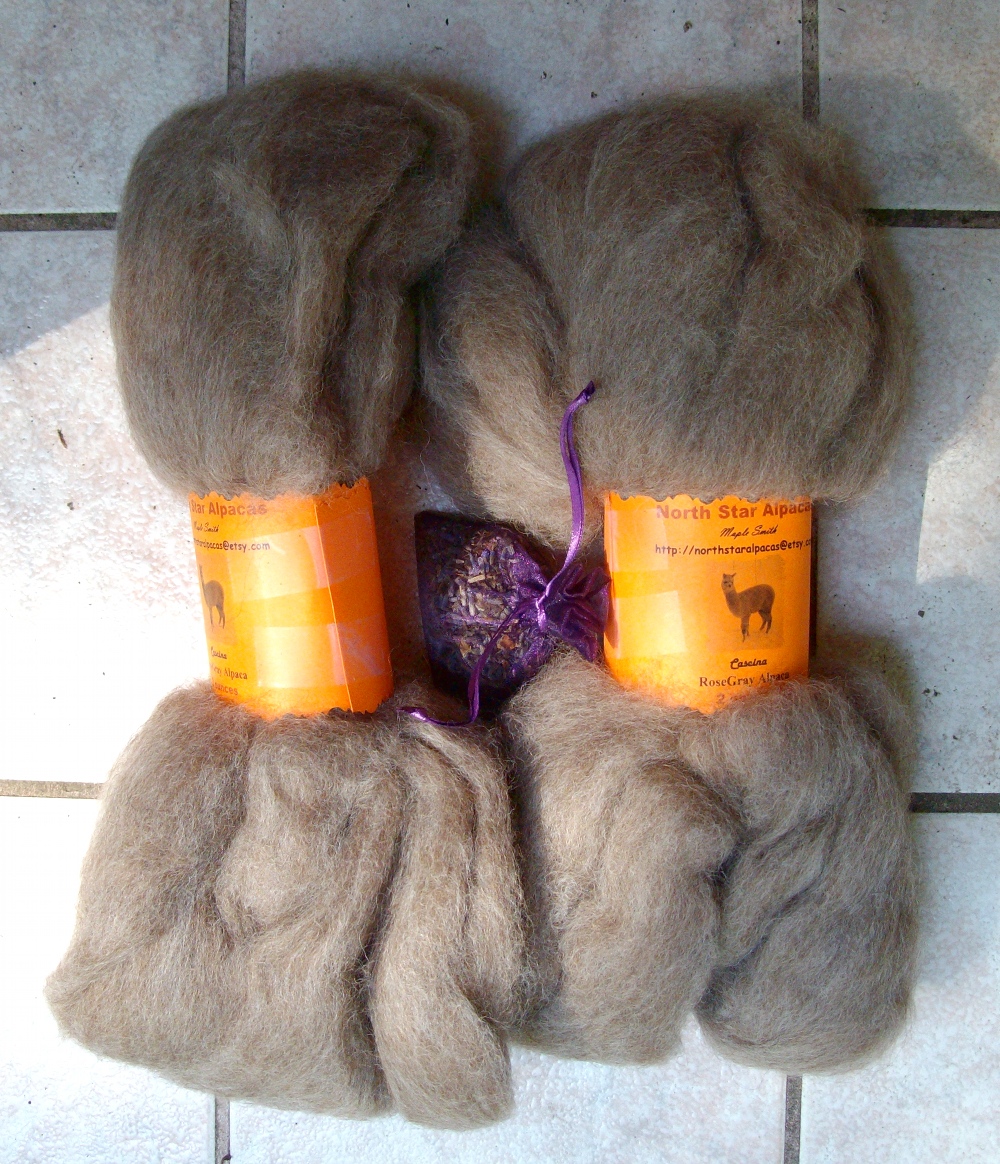
I was right, up to a point: the alpaca — rose gray cria roving (the first real shearing from a baby alpaca) from North Star Alpacas — did spin up quickly. I’d never spun alpaca before (apart from a sample at spinning lessons) and was a bit nervous that I’d screw it up, but the carded prep was smooth like butter, and made for some of the most effortless spinning I’ve ever done. Even worsted spun, the singles were nicely fuzzy, and the softness…oh, the softness. Plus, Maple had put a lavender sachet in the bag, so I’d get these delightful wafts of lavender as I spun it up. Even Chicken-Leg Al the Wonder Cat was powerless against it: he took about 3 seconds to go from, “Hmmm, what’s this new fluffy thing?” to full-on drooling alpaca faceplant. About halfway into the first ounce, I went back to the site and bought another 4 oz. You can see where this is going.
This is what I love about the internet. The roving came from this adorable animal, who lives down the road from Maple, the woman from whom I bought it. Photo from North Star Alpacas, used with permission.
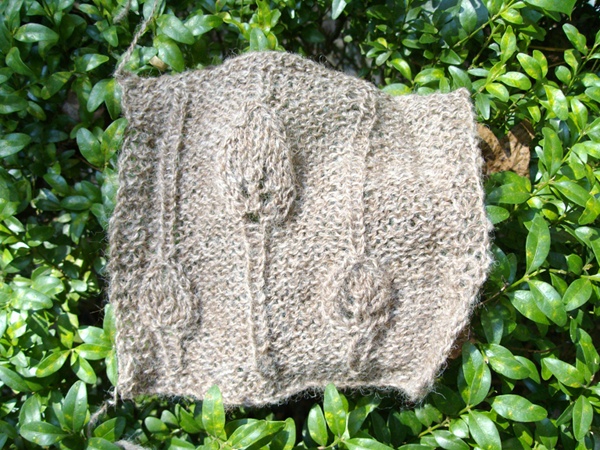
Around the same time, I realized that we had a 6 hour road trip coming up — 3 hours each way — and none of the projects on the needles would make for good car knitting. They all require charts and/or concentration, which is a recipe for nausea and much ripping out of mistakes. Why not cast on something with my newly made yarn? Something simple; something that didn’t require charts; something I could knit without looking at it too much; something to show off the handspun-ness of the yarn. So I did some swatching and came up with a stitch pattern I liked.
There were a couple of swatches before this, but I wasn't wasting handspun in failed stitch patterns. No, ma'am.
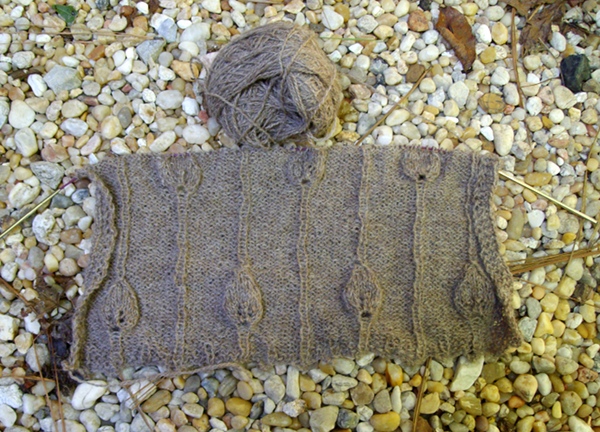
I got about 250 yds/229 m of 2-ply from a generous 2 oz/57g of roving, so I’d end up in the ballpark of 750 yds/687m, which might be enough for a shawl, if I made it narrower than my usual giant wrap. If not, I could always spin some more. Perhaps I should order another 2 oz to be safe. A shawl, yes. That will take rather more than 6 hours and require the spinning of another 4-6 oz of roving.
You know, a little car knitting.
It will take several more trips to Atlanta to finish this sucker.
Being Part II of the tale of the handspun spinning slippers. Part I is here.
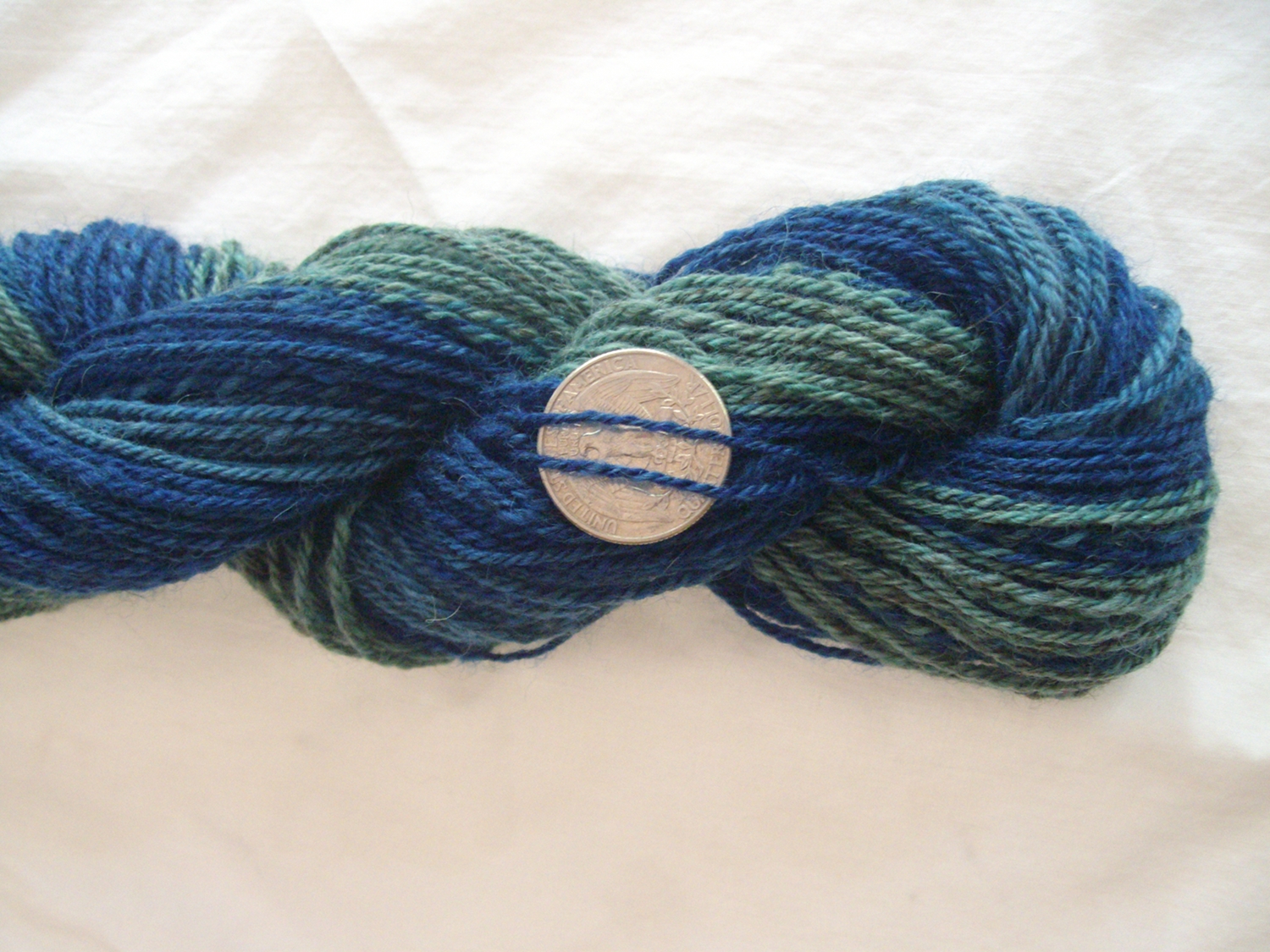
So I have my lovely yarn:
and I want to turn it into slippers like these. There are a few complications, though: the handspun is probably a bit heavier than the recommended yarn (which I would know for sure if I had a gauge to measure wraps per inch, or even a wooden ruler that was less than a yard long. I don’t. It’s on my list.); I don’t have a lot of it, and don’t want to use any of it to make a gauge swatch; I’m impatient — this is my first usable yarn, and dammit, I just want to make something; the pattern is ‘one size’, and I can guarantee you that size will not accommodate my rather large feet. I was going to have to wing it.
At this point in the story, I run into a quandary, dear reader. I would love to say exactly how I made the slippers, but I won’t. The result is too much like the original design, and I can’t in all conscience post detailed instructions for making them here when Reiko has gone to a lot of trouble to write a pattern, especially since she is using the proceeds to help people. Also, did I mention that I didn’t do a gauge swatch? So I won’t be providing numbers here; you’ll have to buy the pattern for those. It’s two and a half bucks.
In my humble opinion, the best way to make socks or sock-like foot coverings when you’re short on yarn and/or can’t be arsed to swatch is to do them from the toe up. You run the risk of getting to the heel and finding they don’t quite fit right, but then you haven’t done much more knitting than the swatch would have taken, and you can always rip back. It’s probably a bad idea to do this for yarn with more than about 10% silk (which might grow with washing) or with yarn you’re not that familiar with (again with the post-washing surprise potential), and if you’re planning to machine wash the finished object and haven’t used that yarn before, for the love of all the work you’ve done, make a swatch and wash it the way you’ll wash your socks. That said, there’s something freeing about seat-of-the-pants, toe-up, swatches-be-damned sock making. We’re living on the edge, here.
The Comfort Slippers pattern is top-down, so I’d have to work backwards. I took the end stitch count from the pattern and added a couple of stitches for extra foot width, grabbed two circular needles of what was probably the right size and cast on with Judy’s Magic Cast On. What’s the right size? Well, you’re shooting for a dense fabric, so whatever needle will give you that. If it doesn’t feel right after a few rows, try again. It’s only a few rows; better to redo them than to have drapey socks or socks that stand up on their own.
I increased where the pattern had decreases, trying them on as I went, until they seemed about wide enough (i.e., a bit too loose, as the knitting would pull back once the needles weren’t holding it out). Actually, my increases are a bit closer together, and I wish they weren’t. The next pair, I’ll separate the increases more to make the toes more like the original. When the toe was a bit short of where I wanted it (to allow for edging), I cast off the number of centre top stitches that the pattern had you cast on, did a few more decreases to open up the foot, then knit straight until I was a couple of inches short of the heel. Now, these slippers weren’t going to be worn in shoes, and I was not feeling very mathy, so I just did a short row heel instead of the reinforced heel. More edge decreases to open up the heel, then straight knitting until the back heel was about the height that I wanted it, minus a bit for the strap. Then I picked up stitches around the foot and, ignoring the heel stitches, did three rows of 2×2 ribbing on the picked up stitches, decreasing on the second row where I wanted corners (on each side of the toe and at the turn for the ankle), and binding off in the same rib, leaving the one remaining bind off stitch on the needle. Looking at the pattern again, this is not at all how she did the edging, and I like hers better, so that’s probably what I’ll do next time. I picked up one stitch along the short side of the foot edging just worked, knit across the back, picked up two stitches on the other edge, then cast on stitches for the strap until I had the same number as the pattern. (My ankles are narrower than my feet, so between that and the slight difference in gauge, I figured that would work.) A few rows of 2×2 (until it was about as long as I wanted it), bind off in rib, and voila!
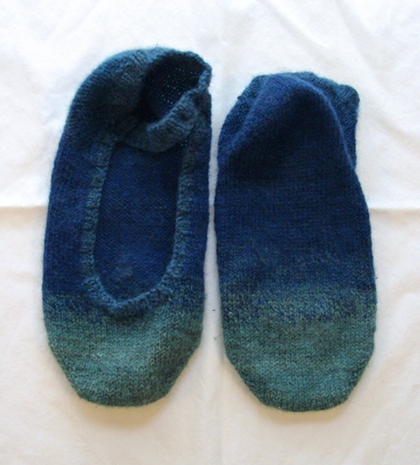
These are some well-loved slippers.
They say that you don’t really learn what your handspun yarn is like until you knit with it, and they’re right. This yarn was pretty in the skein, but a bit hard. Knit up, though, it softened and opened up even before the final wash. (I knit English style — with the yarn in the right hand — which opens up the twist a bit.) After a light blocking, by which I mean give the thing a bit of a soak and dry flat, they were soft and cozy and a bit fuzzy and everything I’d hoped they would be. The slight difference in each single made the colours flow nicely into each other, though I’d had to cut out a fair bit of the darker blue to get the light blue in. And just as I had imagined at the beginning, whenever I get frustrated or bored with something I’m spinning, I look down at my slippers and remember how rewarding the whole process will be.


 E. Elliott Knits